Modernizing Without Forgetting ! China’s Model for Heritage Preservation and Timor-Leste’s Path Forward
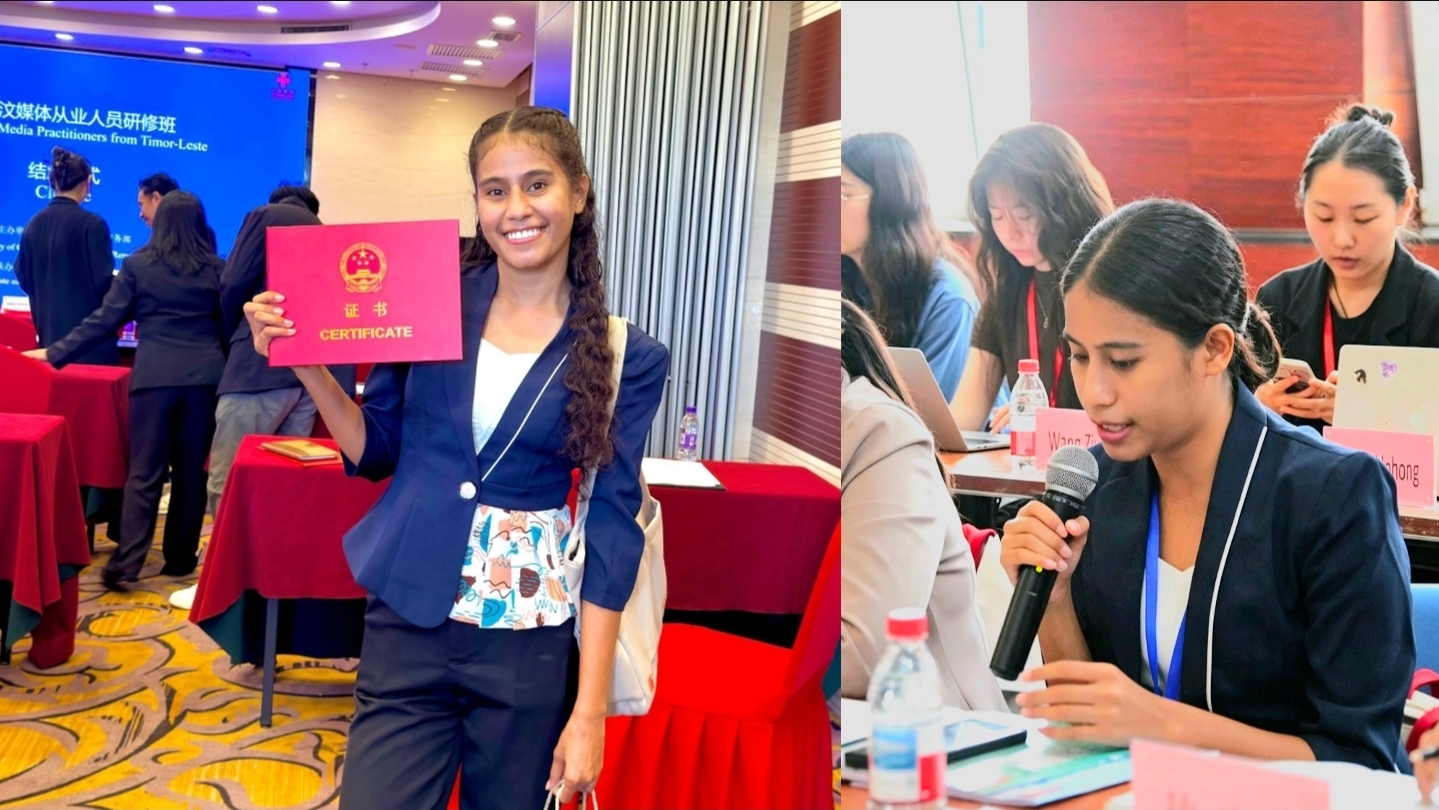
Imajem : Marciana da Conceição iha Beijing, 04/08/2026.
SAPNewsTL, China, 04/08/2026 : The People’s Republic of China (PRC) is a large nation in East Asia with a population of 1.41 billion, known as a civilized, modern, revitalized, developed, innovative and technological country. This nation, whose capital is located in Beijing, has great influence in the world because it dominates technology, artificial intelligence, social communication, transportation, infrastructure, and the global economy through production, use, and export to the global market.
Marciana da Conceição – SAPNewsTL
After taking part in training and a study visit in China, I gained a variety of material and experience from this opportunity. Among these lessons, I was particularly interested in “China’s National Conditions and Traditional Culture,” a subject that clearly defines how national conditions relate to the development of cultural heritage, national infrastructure, the revitalization of traditional houses, urban conservation, and infrastructure planning within the process of modernization.
China’s traditional culture has a history spanning more than 5,000 years, which has become an important foundation for China’s national identity to this day. According to the moral doctrines of Confucianism, Taoism, and Buddhism, these strongly mark the social values of the people. These three doctrines inspire harmonious relationships within the family, respect for ancestors, moral duty toward society, balance, simplicity, and seeking to live in accordance with the natural flow rather than struggling against nature, along with loyalty and hope. These values continue to have a great influence on contemporary Chinese social behavior, even as the nation undergoes modernization and globalization.
China is famous for various arts such as calligraphy, traditional painting, Chinese opera, and ceramic craftsmanship. Traditional festivals such as Chinese New Year (Spring Festival), the Mid-Autumn Festival, and the Dragon Boat Festival continue to be celebrated with great enthusiasm from generation to generation. Chinese cuisine has also become an important part of cultural identity, with very rich regional variety, from spicy Sichuan food to delicate Cantonese cuisine.
China represents a unique combination of rapid modernization and the preservation of cultural tradition. The Chinese government continues its efforts to promote and protect national cultural heritage, as reflected in UNESCO’s recognition of various historical sites throughout China. Understanding China’s national conditions and traditional culture is very important for strengthening international relations and cooperation among peoples in today’s globalized world.
During the presentation, the specialist spoke about a model of conservation and preservation of national cultural identity that is integrated into economic, infrastructural, social, and technological development within the process of urban modernization. In this way, there continues to be continuity and integrity, bringing progress and a better life for its population.
The exchange program stimulates journalists’ knowledge about China’s development, China-ASEAN cooperation, the Belt and Road Initiative, China’s modernization, and the international communication system in the People’s Republic of China. The Timorese delegation visited media institutions and innovation centers, the Central Gifts and Artifacts Center in Beijing, the Museum of the Communist Party of China, and the Capital Museum in Beijing, to see firsthand how China preserves the artistic works conserved in museums from each decade, and how its history has shaped it into a developed nation with its own historical pathways.
A wonderful experience was gained in the city of Beijing and in Guangxi, down to Liuzhou, observing how Artificial Intelligence (AI) is used in the fields of health, agriculture, digital communication, rural development, environmental conservation, cultural integration, tourism, and industrial innovate on.
In recent decades, rapid economic development and urban expansion have posed a major threat to traditional communities through the destruction of sacred houses (uma-lulik) and ancestral houses (uma-tuan), which hold great cultural and historical value. The Chinese government has begun to recognize that modernization is not just about building tall, modern structures, but about integrating safeguards for cultural identity through controlled rehabilitation programs, so as not to lose the historical foundation and national culture. This revitalization takes an integrated approach that focuses on improving communities’ quality of life, where today it is used to support cultural tourism, the local economy, and improve people’s livelihoods.
Revitalization uses techniques that integrate tradition with new technology to improve basic infrastructure such as water and sanitation systems without damaging the original design and traditional materials such as wood, stone, and lime. Vernacular heritage continues to live on and provide new benefits for rural economic development.
The development of social communication, alongside digital platforms and innovation capacity, consistently defends, protects, and promotes China’s cultural identity. China’s experience offers an important lesson for Timor-Leste: sustainable urban and technological development cannot be separated from history and culture, but must look back to the past as a foundation for building a great future rich in cultural color through the protection of cultural heritage. Modern cities in China are not only economic centers but also places that firmly hold collective memory from generation to generation.
The modernization of cities in China has faced criticism for attempting to demolish historic quarters in order to build tall buildings. Today, China has aligned itself with international standards (such as recognition by UNESCO) to choose only conservation approaches that do not displace local communities and do not extinguish the “living memory” of populations who have long resided in these places.
The greatest challenge in this planning is how to invest in modern infrastructure such as water, sanitation, and internet in cities without damaging traditional structures. China uses international approaches such as Transit-Oriented Development (TOD) and highly advanced underground construction, through underground piping networks, as well as metro stations designed in accordance with local architectural design.
One of the points in which China leads globally is its use of Smart City technology for heritage conservation. Through the use of Digital Twins, IoT sensors, and artificial intelligence (AI), monitors can track changes to wooden structures, water quality in canals, and even manage tourist traffic flow. The experience that China has developed offers a new lesson to the world, including Timor-Leste, that modernism and history can move forward together as a sustainable foundation for cities in the future.
During this training, I gained new inspiration regarding China’s development model, which combines AI, cultural preservation, the valorization of history, infrastructure development, and technological advancement. The greatest lesson from this experience teaches that development must be based on long-term planning, which stands as a major lesson for underdeveloped nations, including Timor-Leste.
The integration of tradition and infrastructure modernization stands as a lesson for Timor-Leste — how to integrate modernization while ensuring cultural identity and vernacular heritage. Our nation needs to modernize its basic infrastructure such as water systems, sanitation, and lighting, but this development must use innovative techniques that respect and protect the original design and traditional materials.
I am proud of Timor-Leste’s efforts to protect and preserve its history. One important lesson is that infrastructure development, urbanization, and housing must integrate the protection of cultural heritage, traditional houses, historical sites, and local knowledge.
I gained a deep impression during this trip from China’s technological innovation, its advanced and professional media development, modern infrastructure, and modern economic growth. I also observed a civilized society, strong regulations regarding social media, a clean and beautiful environment, and characteristics of the Chinese people such as punctuality, discipline, hard work, diligence in study, mutual respect, preservation of cultural heritage, humility, and public order. It is also important to note that there is no noise in public places and no wasting of time on non-essential matters. Family formation also follows clear rules: the minimum marriage age is 22 for men and 23 for women, with a maximum of three children per family.
This study visit provided a deep understanding of the multidimensional nature of national development. China’s progress, advancement, and success in national and international media sustainability, as well as its modern economic growth, are rooted in visionary political leadership, strong laws and regulations, strategic investment in infrastructure, continuous technological innovation, inclusive social policy, and the preservation of cultural identity.
During this study visit, the areas of focus included digital communication, public policy, infrastructure modernization, technological innovation, artificial intelligence, and social welfare. I observed that China stands as an important example of integrated, inclusive, and sustainable national transformation and innovation. The experience in China demonstrated that sustainable development requires political leadership with a clear, strong, and consistent vision, integrated and coordinated planning, and capable public and private institutions to ensure effective implementation.
The government continues to invest in the development of communication, digital artificial intelligence, and infrastructure modernization that supports economic growth and improves quality of life, particularly through urban parks, public transportation systems, accessible facilities for people with disabilities, and public digital services.
This young nation can begin using digital technology and innovation to monitor and safeguard heritage structures from damage, thereby demonstrating that technology and the past can move forward together, so that cities become economic centers as well as places that firmly hold the nation’s collective memory.
As a newly developing nation, with social communication not yet strong, Timor-Leste’s sustainable rural and urban development cannot be separated from its history and national identity. The protection of cultural heritage and traditional villages must stand as a central pillar, so that progress and forward-moving development can bring benefits, wellbeing, and continuity for both present and future generations.