Science for Development Summit Calls for Greater Investment in Timor-Leste’s Human Capital
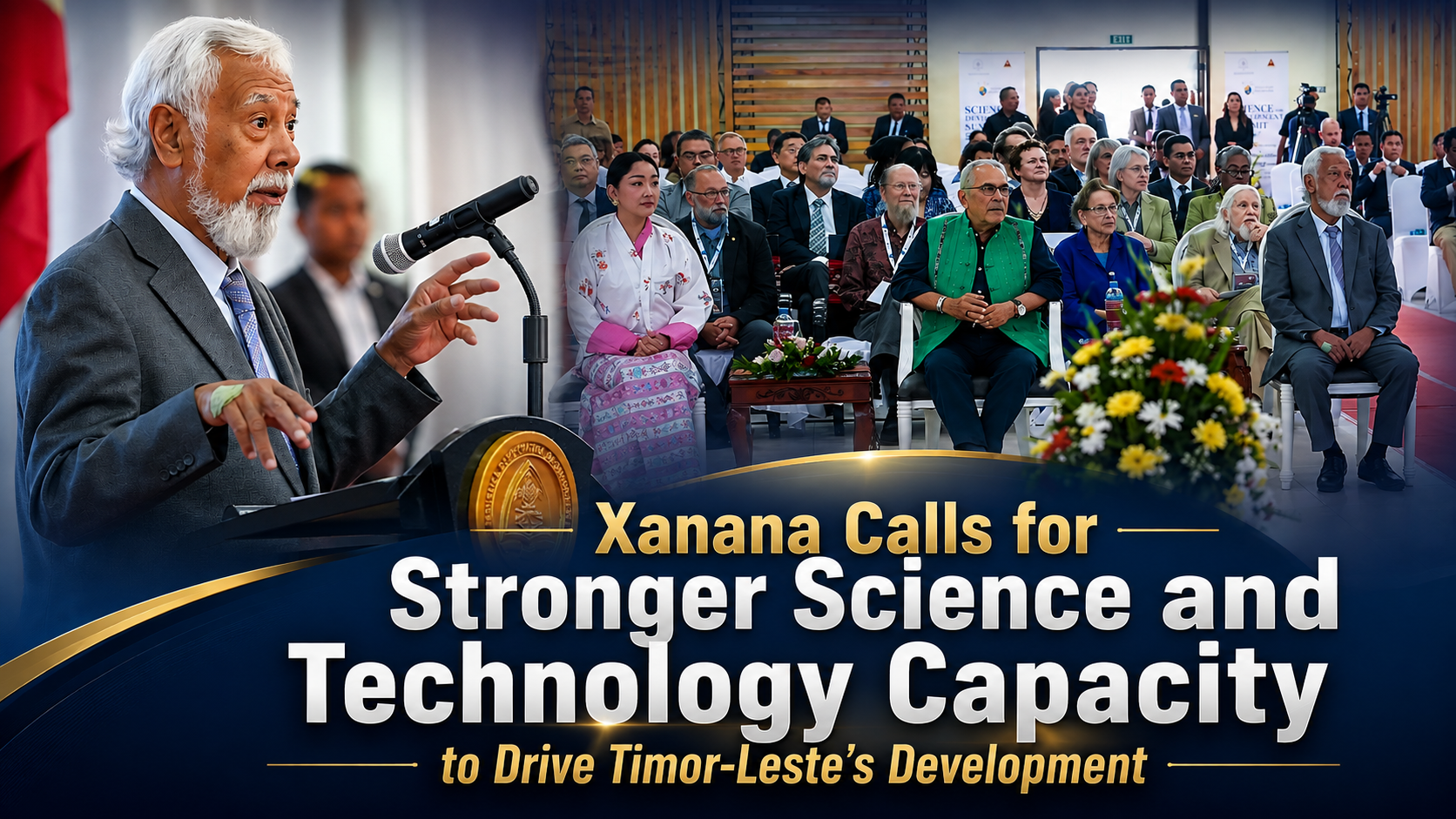
Imagem : Prime Minister Kay Rala Xanana Gusmão in Dili, 24/08/2026.
SAPNews-TL, Dili – During the opening of the Science for Development Summit 2026, Prime Minister Kay Rala Xanana Gusmão called on Timor-Leste to strengthen scientific knowledge, human capacity, and education in order to respond to rapid technological changes and promote national development.
Prime Minister Xanana Gusmão emphasized that science and technology play an important role in improving people’s lives and creating new opportunities for Timor-Leste.
“Science and technology play an important role in improving people’s lives and creating new opportunities for Timor-Leste.” The Prime Minister made the remarks during his address at the CCD on Monday, 24 August 2026.
He stressed that Timor-Leste cannot afford to be left behind in technological development, particularly given the rapid advances taking place in fields such as Artificial Intelligence (AI), biotechnology, computing, and medicine.
“Timor-Leste cannot afford to be left behind in this new technological era, as developments in science and technology are advancing very rapidly, particularly in areas such as Artificial Intelligence, biotechnology, computing, and medicine.”
Prime Minister Xanana said that AI could provide significant benefits to Timor-Leste, particularly in the health, education, agriculture, and business sectors. However, he also warned that both the Government and society must understand the risks associated with emerging technologies, including fraud, disinformation, and threats to national sovereignty.
“Artificial Intelligence can bring benefits to Timor-Leste, particularly in the health, education, agriculture, and business sectors. However, the Government and society need to understand the risks associated with this technology, including fraud, disinformation, and threats to sovereignty.”
The Prime Minister also called for stronger scientific and technical education and for universities to further develop their institutional and academic capacities.
“We need to strengthen scientific and technical education and develop the capacity of our universities to prepare our young people for the challenges of the future.”
Prime Minister Xanana further appealed to international participants and guests to share their knowledge and experiences with Timor-Leste, enabling the country to better understand the challenges and opportunities emerging in the new scientific and technological era.
“International guests should share their knowledge and experiences with Timor-Leste so that we can better understand the challenges and opportunities of this new era.”
The Head of Government noted that, over the past 24 years, the people of Timor-Leste had struggled for sovereignty because they believed that the country had the right to determine its own future. However, he emphasized that independence is not simply about having a national flag, a national anthem, or a seat at the United Nations.
“Independence must create opportunities to improve people’s lives. It requires better healthcare and education, food security and productive agriculture, as well as an economy that creates jobs and opportunities for young people.”
He also identified the shortage of skilled and specialized human resources as one of Timor-Leste’s major challenges. The country will need time to train and develop doctors, engineers, scientists, teachers, business professionals, and other specialists.
“Science changes what people are able to do. For Timor-Leste, this is particularly important because one of the major barriers to our development is the lack of people with the necessary skills and specialized expertise.”
According to the Prime Minister, investment in human resources remains essential. New technologies can help strengthen existing human capabilities and provide broader access to knowledge.
He cited Artificial Intelligence as an example, noting that it can help health professionals access medical knowledge, enable people to access information in their native languages, and support farmers in using scientific information about crops and weather conditions.
AI can also assist young entrepreneurs who have ideas but lack the resources to hire accountants, programmers, translators, researchers, or marketing advisers.
President José Ramos-Horta also welcomed the global experts attending the summit and emphasized that Timor-Leste must evolve from being a consumer of knowledge to a creator of knowledge, through the integration of local science and engineering.
“This summit is not simply about bringing people together; it is a declaration that Timor-Leste is ready to move beyond consuming knowledge and begin creating knowledge.”
The Head of State stressed that Timor-Leste must transform its natural and human diversity into solutions in the areas of agriculture, health, education, and sustainable prosperity, with young people playing a central role in the country’s future.
The Science for Development Summit 2026 is an initiative of President José Ramos-Horta, who was awarded the Nobel Peace Prize in 1996. The summit brings together Nobel laureates, Turing Award winners, scientists, innovators, thinkers, educators, researchers, and leaders from around the world.
The summit is also part of a series of strategic national events taking place in August 2026, with the objective of raising Timor-Leste’s international profile and promoting sustainable development through education, diplomacy, and international cooperation.
The summit also features an exhibition with more than 70 exhibitors from schools, universities, government institutions, private-sector partners, and development organizations. The exhibition includes student projects from schools across the municipalities, including EBC St. Antonio Teulale in Baucau, ESGP Nino Konis Santana in Lospalos, and Colégio de Santo Inácio de Loiola in Kasait.
University researchers from the National University of Timor-Lorosa’e (UNTL), Universidade Católica Timorense (UCT), and Dili Institute of Technology (DIT) are also participating, presenting projects and demonstrations in areas including agricultural engineering, health sciences, and teacher education.