
UNFPA and MSSI Strengthen Partnership to Combat Gender-Based Violence in Timor-Leste
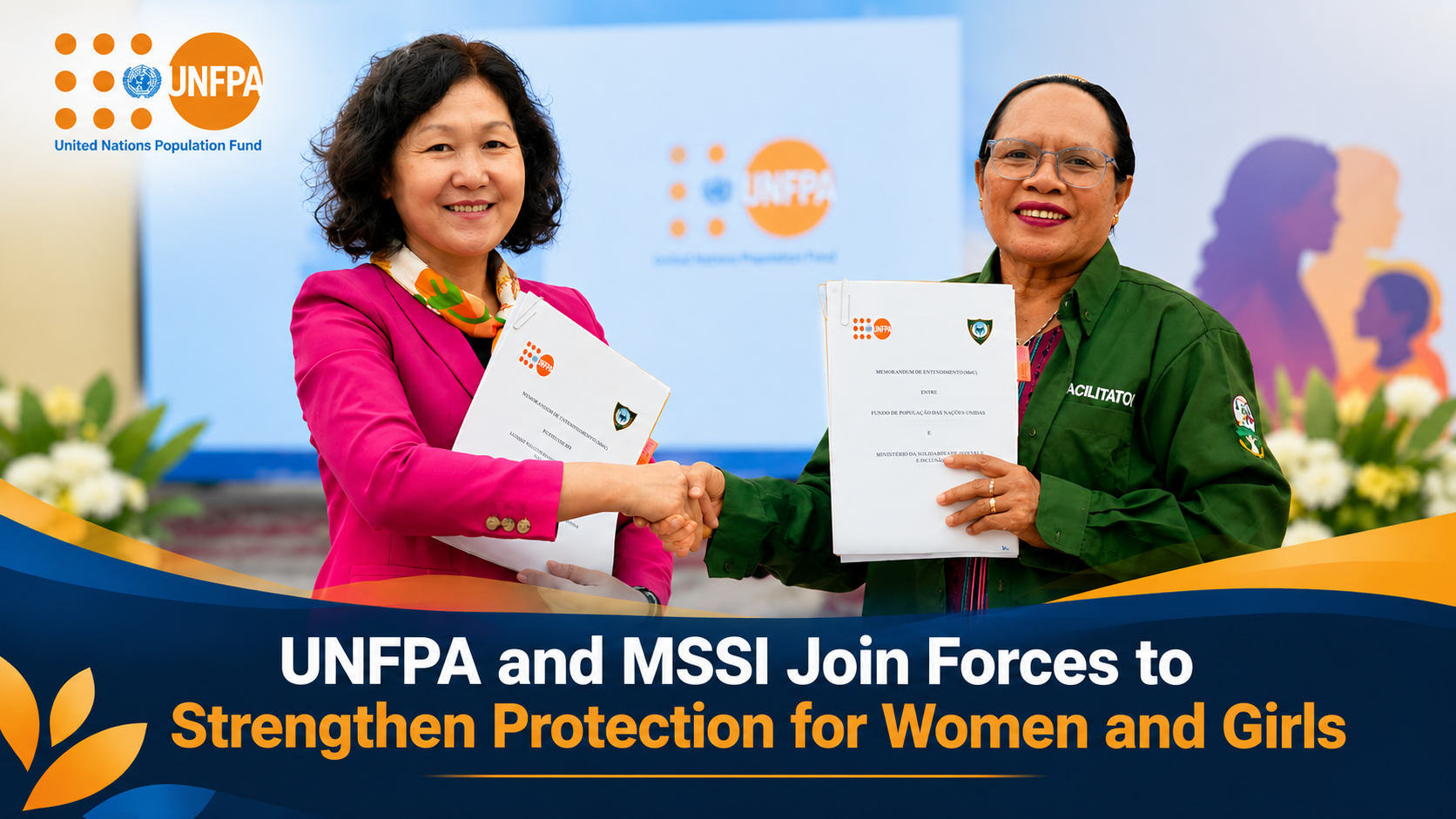
Image : UNFPA Representative in Timor-Leste, Navchaa Suren & Minister of Social Solidarity and Inclusion Verónica da Dores in Dili, 24/08/2026.
SAPNewsTL, Dili: The United Nations Population Fund (UNFPA) has signed a Memorandum of Understanding (MoU) with the Ministry of Social Solidarity and Inclusion (MSSI) to continue supporting efforts to combat Gender-Based Violence (GBV) in Timor-Leste.
UNFPA Representative in Timor-Leste, Navchaa Suren, said, “Today, we signed a Memorandum of Understanding with the Ministry of Social Solidarity and Inclusion to continue our partnership in supporting the Ministry’s efforts to combat Gender-Based Violence in Timor-Leste.” The UNFPA Representative made the statement during the signing ceremony at the MSSI Hall in Caicoli on August 24, 2026.
The ceremony represents a commitment to ensuring that when a woman or girl experiences violence and seeks assistance, there will be someone to listen to her, support her, and provide protection.
“We know that GBV remains a challenge. According to the 2016 DHS, one in three women (38%) has experienced physical or sexual violence during her lifetime. Nearly 60% of them will never seek help because of fear, shame, and a lack of confidence in available services.”
UNFPA is supporting the Timor-Leste DHS 2025–2026, working closely with the Ministry of Finance and INETL. The main report, which will be launched in October, will provide updated data on GBV.
“We look forward to seeing positive changes in key indicators, while the new evidence will help us assess the progress and strength of the interventions and programmes that have been established.”
One of UNFPA’s Global Transformative Results is to end gender-based violence and harmful practices against women and girls. Preventing GBV strengthens human capital, empowers women and girls to fully participate in education, employment, and community life, and contributes to stronger families and communities, as well as a more inclusive and sustainable economy.
UNFPA has provided strategic, evidence-informed, and coordinated support, ranging from establishing Safe Spaces and providing training for health-care providers to advancing comprehensive sexuality education, healthy relationships, positive social norms, community engagement, stronger GBV data systems, GBV prevention and tertiary response, and the national GBV response through the Solidariedade Hotline.
“Under UNFPA’s new Country Programme for Timor-Leste for 2026–2030, which has been approved by the Government, one of our main areas of support will continue to be GBV prevention and response. Our support will be guided by national priorities and plans, such as the National Action Plan on GBV 2022–2032,” she emphasized.
The UNFPA Representative further said that the partnership is a testament to the shared commitment to ensuring that when a woman or girl experiences violence, she has someone who can listen to her, protect her, and provide the care and support she needs.
“Our shared commitment is translated into action through multisectoral coordination, case management, frontline capacity, referral systems, data and information management. We are also providing ICT equipment and office furniture as our modest contribution to support the Solidariedade Service / GBV Helpline.”
This equipment will help connect hotline operators with survivors and facilitate access to life-saving care and support. A call to 116 should not end with a conversation over the phone alone.
“This must connect survivors, according to their needs, with case management, safety planning, health care, psychosocial support, police protection, shelter, and justice. Its success will depend on the quality, availability, and coordination of services behind the hotline.”
“Let us work together to end gender-based violence and build a society where all women and girls can live free from violence and discrimination, regardless of their background or circumstances.”
Minister of Social Solidarity and Inclusion Verónica da Dores said that in this era of technology, it is very important to strengthen the protection of children and women so that they can live free from abuse, discrimination, and exploitation.
“This cooperation is very important. The equipment support from UNFPA will help and create an adequate space, while the Solidariedade Hotline will use a mechanism that is accessible, confidential, responsive, and safe.”
The government official considered the cooperation very important for social protection, particularly the protection of children, women, and communities.
“For victims, being able to use a telephone can be the first step toward ensuring their safety and protection. This cooperation is very important in supporting our joint efforts in the areas of social protection, family support, child protection, and community protection.”
The Minister of Social Solidarity and Inclusion also expressed appreciation to partners such as UNFPA, ChildFund, and UNICEF, which remain committed to contributing to the national development process.