Xanana Gusmão Apologizes to Guinea-Bissau Following Controversy Over “Failed State” Comment
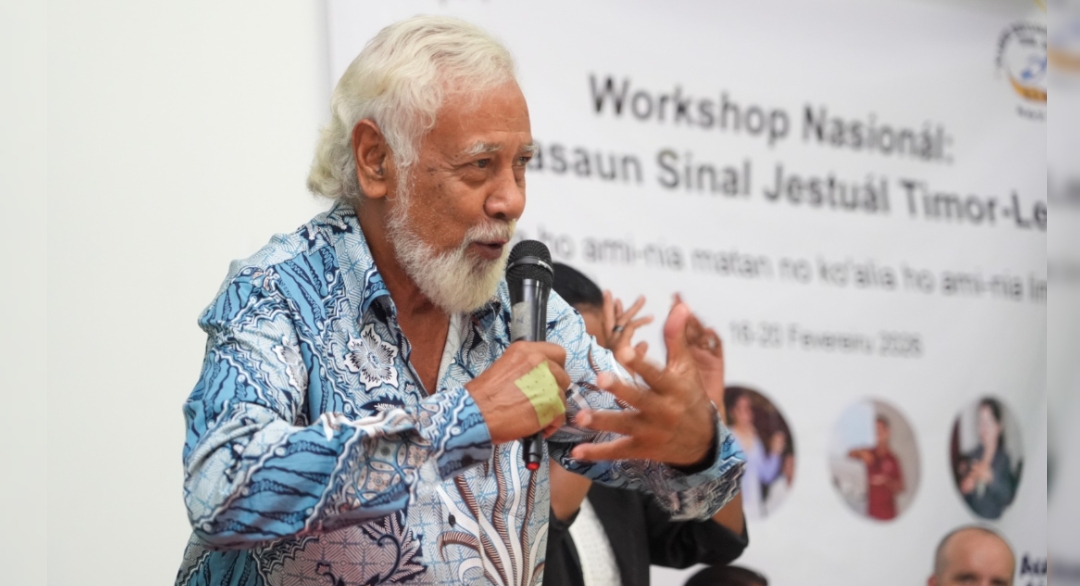
Image : Prime Minister of Timor-Leste, Kay Rala Xanana Gusmão in Dili, 16/02/2026
SAPNewsTL – The Prime Minister of Timor-Leste, Kay Rala Xanana Gusmão, apologized to the people and Government of Guinea-Bissau after remarks he made were considered offensive, following his use of the term “failed state.”
“I apologize to the transitional government of Guinea-Bissau. The President of the Republic (José Ramos-Horta) and I have already decided not to send the mission to Guinea-Bissau; we canceled it because they said Timor-Leste is worthless, and yet we were going to help them. I cannot speak of a crisis, because that’s not the case; I offended them,” he said.
“Now, Timor-Leste is presiding over the Community of Portuguese Language Countries (CPLP) until July 2026. Member countries of the CPLP and their ministers will come to Timor-Leste,” he added.
Previously, Xanana Gusmão’s statement classifying Guinea-Bissau as a “failed state” caused significant tension within the CPLP, dividing opinions between the official outrage of the Guinean government and internal acknowledgment of the country’s persistent political fragilities.
Prime Minister Xanana Gusmão clarified that Guinea-Bissau is not just a fragile state but a failed state. For this reason, Timor-Leste is taking on the CPLP Presidency under the theme “Consolidating the Democratic Rule of Law” for 2026–2027, aiming to support democracy and human rights reinforcement.
During the weekly meeting between President José Ramos-Horta and Prime Minister Xanana Gusmão, the early assumption of the CPLP Presidency by Timor-Leste following the coup in Guinea-Bissau was analyzed.
“There is a political problem in Guinea-Bissau. After last year’s elections, a coup occurred. The Economic Community of West African States (CEDEAO) in Africa tried to help but failed. Guinea-Bissau was to assume the CPLP Presidency but stepped aside and handed it to us. We will assume it for about a year and a half. Therefore, the CPLP requested sending a commission to help resolve the political problem in Guinea-Bissau,” explained the Timorese Prime Minister.
“After 40 years of self-governance, in 2014 we helped set up the entire electoral system, including the National Election Commission (CNE) and the Technical Secretariat of Electoral Administration (STAE), to allow the first democratic elections in Guinea-Bissau. But then there was another military coup,” he said in Dili on 12 February 2026.
Xanana Gusmão added, “With this new coup, we no longer talk about a fragile state but a failed state. Mozambique also faces political problems, and Angola has its own difficulties. When Guinea-Bissau assumed the CPLP presidency, its theme was CPLP and Food Sovereignty. Our theme is Consolidating the Democratic Rule of Law. This issue becomes a major challenge for the CPLP.”
He further emphasized that Timor-Leste, as a co-founder of the G7+, has an important role in analyzing fragile states and an obligation to assist Guinea-Bissau in practicing democracy and human rights.
“Timor-Leste is a co-founder of the G7+, which monitors fragile states. Now Guinea-Bissau has become a failed state. We are pleased that many African countries have transitioned to democratic systems, but we now also have the duty to help Guinea-Bissau on the path of democracy and human rights,” he stated.
In response to this diplomatic statement, the Government of the Republic of Guinea-Bissau, through the Ministry of Foreign Affairs, International Cooperation, and Communities, João Bernardo Vieira, expressed strong indignation over Prime Minister Xanana Gusmão’s remarks classifying Guinea-Bissau as a “failed state.”
“The recent statements about Guinea-Bissau reveal a lack of dignity, political posture, and moral authority to assess the institutional reality of our State. Both Xanana Gusmão and José Ramos-Horta have a history of public controversies that weaken the authority with which they claim to speak on the governance of other countries,” said the press release from the Guinea-Bissau Ministry of Foreign Affairs on 12 February 2026.
The Ministry added: “This is an opportunity to remind Prime Minister Xanana Gusmão that his political career includes widely publicized episodes that raised questions about his conduct, especially during a period when many Timorese fighters faced, on the front lines, the direct consequences of the conflict that devastated Timor-Leste.”
Lamenting the Prime Minister’s statements, João Bernardo Vieira said: “Guinea-Bissau does not accept, nor will it accept, any attempt at public humiliation, political stigmatization, or institutional disqualification, regardless of the source, especially by a CPLP member state whose own trajectory has not always consistently adhered to fundamental democratic principles.”
The Guinean government’s statement sparked diverse reactions among citizens, some of whom recognize the country’s reality, including coups or military uprisings.
Arlindo Timóteo Filipe said, “There’s no point in hiding the truth. Xanana Gusmão spoke the truth. We are facing a state project that has already failed. That’s it. The constitutional order must be restored.”
Carlos Ussumane Bangura expressed sadness at seeing young people attacking José Ramos-Horta and Xanana Gusmão, internationally recognized leaders.
“It’s very sad to see young people who claim to be educated, yet act like puppets. They attack figures of international recognition because of an opinion about the ridiculous and shameful situation the country has faced in recent years.”
Ussumane added that the recent actions of the minister merely show a desire to demonstrate service. According to him, the minister was very lucky to be appointed Minister of Foreign Affairs in the “New Dictator Palace,” replacing those who had always fought to install a dictatorship in Guinea-Bissau.
“Indeed, there could have been a military officer with a better track record to occupy the position and better defend the coup interests. Those who attack everyone because of a shameful coup will not have a promising future,” he stressed.
Mendes de Carvalho noted that institutional indignation always arises faster than self-criticism. When someone speaks out loudly about what everyone knows internally and externally, the response is not to discuss reality but to issue official statements attacking the person with courage.
“Xanana Gusmão may be a controversial figure, but he had the courage to say what many diplomats prefer to whisper. Guinea-Bissau has remained politically unstable for decades, with successive coups and fragile institutions.”
Calling it a “failed state” hurts because it challenges the comfortable rhetoric of diplomacy. However, this label has long appeared in international reports, not merely as a result of theatrical indignation from Guinea-Bissau’s Ministry of Foreign Affairs.
“In essence, the problem is not that Xanana spoke. The problem is that the minister had to admit, even reluctantly, that the truth hurts more than any statement. Those who speak the truth do not deserve punishment; they deserve to be heard.”
Paulo Varela also emphasized that the State of Guinea-Bissau has the right to defend itself and reject labels or adjectives it considers offensive to national honor. However, “we must agree that the reports on governance, the country’s state success, and development progress over 50 years of independence are worrying.”
“Therefore, when there is no agreement that the country needs help due to evident failures, and people continue to only talk, it becomes even more concerning. Beyond failures, denial persists.”
Many arguments have already been heard, and there is agreement on the factors underlying the difficulties in achieving stability. However, problems must be directly addressed.
“It is a process, it is true, but the problem must be acknowledged and named. The Timorese leader called it a ‘failure.’ What name does Guinea-Bissau give its problem? It is no longer acceptable to say it is only a Guinean issue. That theory is outdated and weak in the era of globalization,” agreeing with Xanana Gusmão’s statement.
Djagra Jaquité wrote: “You have not a shred of shame on your wide faces. All of you together do not come close to Mr. Xanana Gusmão.”
Meanwhile, the National Transitional Council (CNT) described Xanana Gusmão’s recent statements as “the delirium of a decaying mind,” considering them not only a diplomatic mistake but also an offense to Guinea-Bissau’s sovereignty.
This reaction was made public on Friday, during a press conference in Bissau, one day after Xanana Gusmão stated that the November coup in Guinea-Bissau demonstrates that the country is a “failed state,” advocating that the international community should help strengthen democracy and human rights.
CNT spokesperson Fernando Vaz strongly criticized the Timorese government’s position, stating that “age has not brought wisdom” to the Timorese leader, and that his words represent an insult to Guinea-Bissau.
According to Vaz, “Timor-Leste’s claim to assume the CPLP presidency is not a sign of unity, but an announcement of a moral funeral for the organization.” — quoted from Rádio Sol Mansi, Bissau, 13 February 2026.
The CNT stated that Guinea-Bissau is a sovereign state, forged in the national liberation struggle, and does not accept being diminished by anyone who confuses political fortune with personal merit.
Meanwhile, President of Cabo Verde José Maria Neves believes that diplomacy and mediation efforts can help find the best path to resolve crises like Guinea-Bissau’s, including the CPLP dispute.
José Maria Neves made this statement to journalists on the sidelines of the 39th African Union Summit in Addis Ababa (14 February 2026), speaking about a bilateral meeting with his Angolan counterpart João Lourenço, during which several CPLP topics were discussed, including Guinea-Bissau’s situation after the November 2025 coup.
“There is a whole mediation effort being carried out by ECOWAS, in which the CPLP wants to participate,” said the President of Cabo Verde, expressing confidence that it will be possible to “pursue the best path” for Guinea-Bissau.
A high-level CPLP mission, whose presidency was taken from Guinea-Bissau after the military coup and passed to Timor-Leste, was expected to visit Bissau next week, but Dili announced it had been canceled.
However, the transitional government of Guinea-Bissau later stated that it had taken the initiative to cancel the CPLP mission, as it did not recognize Timor-Leste’s legitimacy in presiding over the Lusophone community.
When asked if there is an irreparable gap between Guinea-Bissau and the CPLP, José Maria Neves stated that “nothing is irreparable” and that dialogue makes everything possible, while emphasizing that “diplomacy should not take place in public.”
During the summit, the President of Angola referenced unconstitutional government changes, mentioning Madagascar and Guinea-Bissau, stating that speaking about the need to “restore constitutional order after unconstitutional seizures of power” does not mean “it is restored just because the coup perpetrators hold elections and get elected.”
When asked for his comment, the President of Cabo Verde said simply, “The President of Angola said it all.”
Discussing negotiated solutions for armed and other conflicts in Africa was also part of a meeting with the UN Secretary-General, added José Maria Neves.