From Guizhou-Beijing to Dili: Important Lessons for Infrastructure Modernization and Human Civilization in East Timor
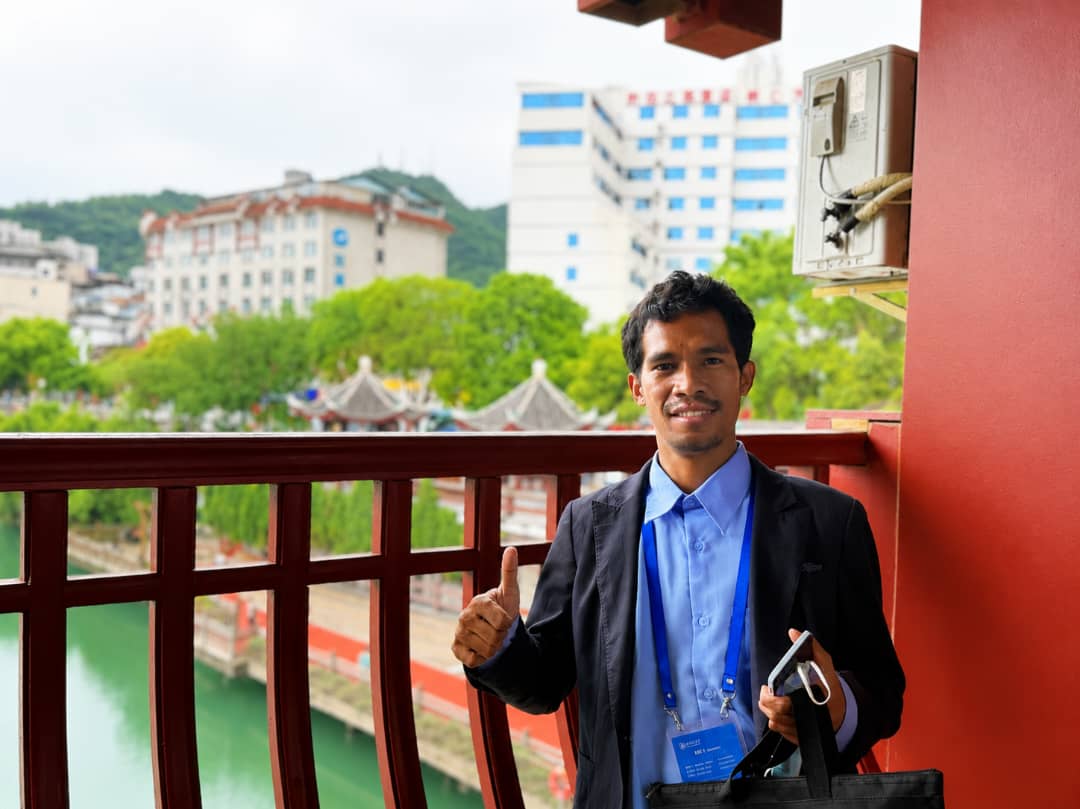
Image : Sergio Alves da Costa in Guizhou, 14/05/2026.
Beijing, 20 May 2026 : Before bearing witness and exploring the experiences gained during my stay in China, I would first like to express my gratitude to the Embassy of the People’s Republic of China and the Government of Timor-Leste for providing me with the opportunity to participate in the training and study visit to Shanghai, Beijing, Guizhou, Tongren, and Jiangkou County.
I looked first at the history of Mao Zedong (1949–1976) following the victory of the Chinese Communist Party in the civil war, which successfully proclaimed the People’s Republic of China (PRC). In its first decade, the government focused on industrial base development, land reform, and establishing a new system based on socialist ideology. Despite facing major challenges and crises, this phase served as the foundation for national sovereignty and built China’s industrial and military base.
After the passing of Mao Zedong, Deng Xiaoping (1978–1989) assumed leadership and took a new direction through the “Economic Reform and Open-Up” policy in 1978. This policy shifted China from a centralized economy to “Socialism with Chinese Characteristics,” which also embraced market elements. China began to accept foreign investment, created Special Economic Zones, and drove modernization in the fields of agriculture, industry, science, and defense.
In the 1990s and 2000s, China demonstrated the largest and fastest economic growth experience in the world. This transformation lifted millions upon millions of people out of poverty and marginalization, while driving urbanization and development. Since 2012, President Xi Jinping has led China into a “New Era” that focuses more on the quality of growth, technological innovation, and sustainable development. In the international context, China has affirmed its position as a global power through major initiatives such as the “Belt and Road Initiative,” the development of smart cities, and advanced technology, becoming a strategic development partner for many nations, including Timor-Leste.
This short article bears witness to the economic, political, social, and cultural development in the aspects of infrastructure and technological innovation in the People’s Republic of China, through a bilateral capacity-building program conducted between the Chinese Embassy and the Ministry of Rural Development and Community Housing (MDRHC) of Timor-Leste, which concluded in May 2026.
While attending lectures, discussions, and study visits in Beijing, Guizhou, and Tongren regarding public policy, infrastructure modernization, technological innovation, and social well-being, the author noted that the People’s Republic of China (PRC) serves as an important model and example of integrated, inclusive, and sustainable national transformation and innovation, despite managing a total population of 1.41 billion (the second-largest population in the world, after India with a population of 1.47 billion).
In the economic context, China considers infrastructure to be the motor that drives national growth and productivity, establishing high-quality infrastructure through a High-Speed Rail network, highways, modern ports and airports, urban metro systems, and industrial zones, as these increase the efficiency of moving people, goods, and services quickly and at a lower cost.
When visiting the China Railway Construction Corporation Limited (CRCC), the exhibition centers, and the BJTU (Beijing Jiaotong University) laboratories, it became evident that infrastructure and technological innovation go hand in hand, grounded in scientific and academic research. As a result of the strategies and investments carried out over the past decades, today the People’s Republic of China has become a user, producer, and exporter of technology worldwide. On the other hand, the Guizhou Guicha Group utilizes automation and smart production systems to transform traditional agricultural products, such as matcha, into global commodities that meet international standards. These changes demonstrate that technological innovation increases economic value, reduces poverty, and creates job opportunities for communities.
An important lesson for Timor-Leste’s economy is the need to continue developing basic and strategic infrastructure, as this serves as a strategic investment for national productivity and future economic diversification. This requires a territorial planning system that integrates urban planning, land use, environmental protection, and infrastructure.
During the visit to the Fanrui community in Jiangkou County, the housing policy demonstrated a dual-track housing system model, highlighting active state intervention that guarantees access to housing for vulnerable communities, while leaving room for private investment and balancing market efficiency with social justice.
The experience gained in China shows that sustainable development requires a political leadership with a clear, strong vision, continuity, integrated and coordinated planning, as well as public and private institutions with implementation capacity. Timor-Leste needs to update and develop itself according to its own reality.
In social analysis, the transformation of China’s housing system reflects efforts to respond to the rapidly growing needs of both rural and urban populations. The government continues to invest in social housing, public rental housing, and housing security programs to guarantee access to a dignified life.
The Fanrui community experienced a positive social impact from an integrated public policy through a relocation and dilapidated housing renovation program, which integrated access to education, health, transportation, agriculture, and economic opportunities. People are at the center of development; the infrastructure built supports economic growth and improves the population’s quality of life, particularly through urban parks, public transportation systems, accessible spaces for people with disabilities, and public digital services. In recent years, Timor-Leste has also begun to implement this policy, but it needs to secure, accelerate, and further improve its implementation for the future.
Another important lesson the author found is that technological innovation contributes significantly to social inclusion, particularly through digital health services, online education, e-government, and e-commerce. Furthermore, I also witnessed the modernization and preservation of identity that China demonstrates especially when visiting the Great Wall and the Summer Palace, where modern development continues to integrate and conserve cultural heritage, traditional architecture, cultural landscapes, and historical memory.
During the visit to the Tongren University Museum and the cultural collection of ethnic minorities, I learned that they remain committed to protecting cultural diversity within the context of modernization, given that urbanization and globalization often bring risks to local identity.
I am proud of Timor-Leste’s efforts to protect and preserve its history, and I recognize this very important lesson: infrastructure development, urbanization, and housing must integrate the protection of cultural heritage, traditional houses, historical sites, and local wisdom to guarantee economic progress that does not erase national identity and cultural heritage.
I felt immense pride during this journey, witnessing China’s changes in technological innovation, advanced infrastructure development, modern economic growth, a civilized populace, rigorous social media control, a green city and beautiful environment, and Chinese traits such as punctuality, discipline, hard work, diligence in studying, mutual respect, preservation of cultural heritage, humility, maintaining quietness in public spaces, and not wasting time on unimportant things, as well as forming families according to regulations (man at age 22 and women at age 23, with each family having a maximum of 3 children). This serves as a crucial lesson for Timorese people to emulate and apply according to Timor-Leste’s culture and reality, based on knowledge and wisdom.
To conclude this article, the training and study visit provided a profound understanding of the multidimensional nature of national development. China’s progress, advancement, and success in modern economic growth are driven by a visionary political leadership that invests in strong laws and regulations, strategic infrastructure investment, continuous technological innovation, inclusive social policies, and the preservation of cultural identity. This lesson demonstrates that sustainable development must be approached in an integrated manner, simultaneously considering the economic, political, social, and cultural dimensions. Infrastructure and technology serve as vital instruments to improve the people’s well-being and guarantee sustainability for future generations.
For our Timor-Leste, the essential lesson from this experience is the importance of building our own development model adapted to our national reality, while continuously learning from international best practices through strategic planning, investment in human resources and productive sectors (tourism, agriculture, education, & health), technology, innovation, and good governance. Timor-Leste possesses the possibility and opportunity to build a future that is inclusive, resilient, sustainable, and free of obstacles for future generations.