
Timor Green Pigeon ‘Likely To Go Extinct’ Without Urgent Action
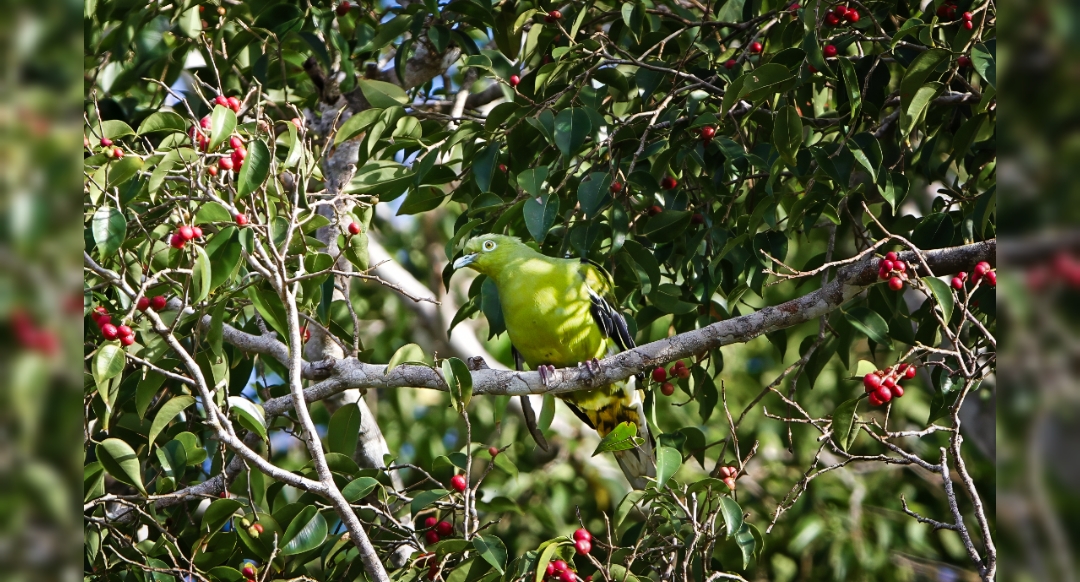
Photo : James Eaton
SAPNewsTL : The Timor green pigeon, which is under pressure from hunting and habitat loss, is at serious risk of extinction and should be uplisted to Critically Endangered, according to a new study from researchers at Charles Darwin University and BirdLife International.
The study, published in Oryx by Cambridge University Press, is the clearest evidence of the rapid decline of the species, which is now estimated to number fewer than 500 individuals in Timor-Leste and is thought to be functionally extinct in neighbouring Indonesia.
The authors of the study say that the Timor green pigeon should be reclassified as Critically Endangered on the IUCN Red List and that urgent action in both countries to save the species, and others like it, is needed.
Dr Colin Trainor, lead author of the study from Charles Darwin University, Australia, said: “I first visited in Timor-Leste in 2002 and on my second day working for BirdLife I got the bus to the village of Tutuala in the far eastern district of Lautem, then walked eight kilometres down the coast where I spotted the Timor green pigeon for the first time.
It wasn’t that difficult to see back then in good forest, but was still exciting because it’s only found on Timor and some of the neighbouring islands.
“I finished my fieldwork in 2006 but have kept going back to Timor Leste ever since, self-funded. Though Nino Konis Santana National Park was founded in 2008, this hasn’t prevented the rapid decline of this and many other species in the area.
“Since 2004 – when I had two records on Rote Island off West Timor – remarkably I have had no records outside Lautem district in Timor-Leste, with the conclusion that they have become increasingly restricted to this well-forested district.”
“It’s very sad to see so few green pigeons left. What we need now is the government, conservation organisations and local communities to come together to stop it being lost forever.”
The study is based on over 1,400 days of field surveys by the authors between 2002 and 2025 throughout the Timor green pigeon’s range, covering Timor-Leste, Atauro Island, Jaco Island, West Timor, Rote Island, and Semau Island. Other historical and contemporary records by ornithologists and birdwatchers going back to 1969 were also included.
In total, there were 96 records of Timor green pigeon, with 74 in Timor-Leste and the majority of these in Lautem district. 82% of the sightings were located in protected areas, particularly Nino Konis Santana National Park.
Based on an assessment of all known field records the authors estimate that there are 100-500 individuals left with the authors suspecting the true number is likely to be at the lower end of this estimate.
Jafet Potenzo Lopes, an author of the study from Conservation International, said: “I was born in Lautem District and have been working here as a conservationist for many years. But so much has changed in that time. Ten years ago you could hike to see the Timor green pigeon, but now it only lives in the most remote areas.
“It is very difficult to convince hunters to change their behaviour, because it’s part of the culture. But I think we need to ask people how they’d feel if this bird disappears. Hunters may like the meat, but if nothing changes soon there will be none.”
The island of Timor is divided into Indonesian West Timor and Timor-Leste, which gained independence from Indonesia in 2002 and was formerly known as East Timor. The island is located in a unique area known as Wallacea that separates Asian and Australian fauna, and hosts a high number of species found nowhere else (endemic species).
The Timor green pigeon, a fruit-eating bird the colour of a green mango, is one of these endemic species. It is part of the Columbidae (pigeons and doves) family, which is one of the most threatened bird families globally. Despite being listed as Endangered since 2000, little has been done to protect the species since then.
Alex Berryman, Senior Red List Officer at BirdLife International and a co-author of the study, said: “The Timor green pigeon may now be one of the bird species most likely to go extinct anywhere in Wallacea – a biodiversity hotspot renowned for its concentration of threatened species.
Unfortunately, our conclusion is that the species is already functionally extinct in Indonesia, leaving conservation efforts in Timor-Leste crucial for its survival. Timor-Leste remains frustratingly overlooked in conservation – and that urgently needs to change.”
Dr Trainor concluded: “Though the situation is dire there is still hope for the Timor green pigeon. The biggest threat to the remaining population comes from probably quite a small number of hunters, so there is an opportunity to change their minds, either through reason, financial support or a combination of both. Hunting is part of the local culture, but unless something changes there will be no Timor green pigeons left to hunt within a few years. We need urgent action and we need it as soon as possible.”
Notes to Editors:
For more information, please contact:
Dr Matt Midgley
+44 (0)1223 342979
matthew.midgley@cambridge.org
Publication:
Colin Trainor et al. ‘Timor Green Pigeon Treron psittaceus of eastern Indonesia and Timor-Leste may be on the verge of extinction’ is published in Oryx (Cambridge University Press) and is strictly embargoed until TBC
DOI: https://doi.org/
About Cambridge University Press & Assessment
Cambridge University Press & Assessment unlocks the potential of millions of people worldwide. It provides world-leading academic research, learning and assessment globally, backed by the first-class teaching and research departments of the University of Cambridge.